



The key points of changing car oil to gas
How safe is the car after oil to gas conversion?
Although natural gas is a flammable and explosive gas, its safety performance is better than gasoline through a series of safety measures, mainly reflected in the following aspects:
① High ignition point. The ignition point of natural gas is above 650 ℃, which is 223 ℃ higher than the ignition point of gasoline at 427 ℃, making it less prone to ignition compared to gasoline;
② Low density. The relative density with air is about 0.58-0.60, and the leaked gas quickly dissipates in the air, making it difficult to form a concentration of combustion upon contact with fire;
③ High octane rating. Up to 130 octane rating, much higher than the current best 96 octane gasoline, with good anti knock performance;
④ The explosion limit is narrow. Only 5-15%, while gasoline accounts for 1-7%. In natural environments, it is very difficult to form this condition;
⑤ The release process is an endothermic process, and when compressed natural gas leaks out of a container or pipe, a low-temperature zone quickly forms around the leak, making it difficult for natural gas to burn;
⑥ The country has issued strict technical standards for natural gas vehicles. Strict technical standards have been established at every stage, from the design of gas stations, production of gas cylinders, manufacturing of modified vehicle components to installation and commissioning;
⑦ Strict security measures have been considered in the design examination. For the components used in the high-pressure system, the safety factor is selected to be 1.5-4 times or more. Safety valves are installed on the pressure regulator and gas storage cylinder, and emergency shut-off devices are installed in the control system;
⑧ Gas cylinders generally need to be sampled thoroughly for combustion, explosion, falling, shooting and other tests in mass production, and can only be used after passing the tests before leaving the factory. In the 60 years since the development of natural gas vehicles both domestically and internationally, there has never been an accident caused by natural gas explosion or combustion resulting in vehicle damage or death. The fact proves that compressed natural gas vehicles are very safe and reliable.
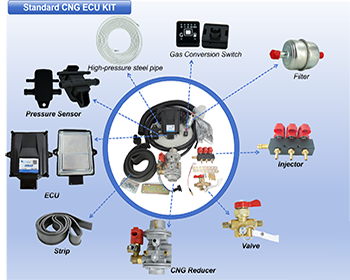
How are cars modified and what should be noted during modification?
Answer: It means adding a set of gas equipment on the basis of the original car, without modifying any parts of the original car, and without affecting the use of the oil circuit. The accessories are installed in a reasonable position on the car.
What kind of car is suitable for gas modification?
Answer:Basically, most car models can be converted from oil to gas, including those with turbocharging. At present, models with direct injection in the cylinder cannot be modified, but this technology is currently under development and may be able to be modified in the future. If the original car has a malfunction or the engine power has dropped too much, it is not suitable for modification. If modification is necessary, it must be carried out at a repair shop first. Only after it is normal can modification be carried out.

Common Misconceptions of Oil to Gas Vehicles
Misconception 1: It is normal for the fault light to turn on after changing the gas, but in fact, 98% of car models can turn on the fault light after changing the gas (not the self deception method of inserting OBD code eliminators, mainly relying on adjusting the correct mixing ratio), except for a few car models, as long as you are willing to spend time, effort, and money, the fault light can basically turn off;
Misconception 2: There is a big difference in oil and gas power, and a gear difference is normal. This is very wrong. As long as the gas accessories (using an electronic control system pressure reducing valve to spray the rail) are not bad and the software is debugged properly, the difference between oil and gas power is only 5-10%, which is almost imperceptible;
Misconception 3: There is no need to install an ignition advance angle. Adding it will not work and will damage the car. This is incorrect. Adding an advance angle is necessary to ensure sufficient combustion when burning gas (because the ignition point of gas is two hundred degrees higher than that of oil). In mountainous areas, models without an advance angle will change the ignition coil spark plug every ten thousand kilometers (because insufficient combustion causes a decrease in power, the ECU will add ignition energy to the ignition coil spark plug). All original CNG models have been equipped with both external and internal components (with the ignition advance angle circuit integrated into the gas ECU)
Misconception 4: Adding a can after changing the gas is like carrying a bomb, which is a very incorrect statement. Before leaving the factory, gas cylinders (CNG) undergo tests such as burning and shooting, making them safer than fuel tanks. Chongqing was the first city in China to enact laws on compressed natural gas, and gas cylinders must be inspected every 2 or 3 years. The online explosion was caused by illegal modification.
Misconception 5: Oil to gas conversion can be done in just one or two hours. In fact, these modifications are just done by the factory to save time, completely following the standards. In fact, a car takes five or six hours. It takes a week of work to debug and test a new car model abroad, and even the same model takes one day.
Misconception 6: CNG debugging is simple and just a few feet of gas is enough. How is this possible? CNG software debugging takes time and requires a road test until 2-3 hours. It is also best to adjust the gas after changing the gas and driving it 5000 to 10000 kilometers. Some car owners only think about adjusting the gas when they have problems driving it 100000 kilometers. At this point, the car already needs to repair the valve, and debugging is useless. Do you need to adjust the gas? It's not normal to see a difference of four to five hundred revolutions per minute in fuel and gas usage at the same speed in your car (for example, if the fuel burns at 120 km/h, the speed is 2800 revolutions per minute, and the gas burns at 120 km/h, the speed is 3200 revolutions per minute). During the period when the engine is not in a healthy state and running for a certain number of kilometers (when the mileage is low, it is equivalent to a young body with strong resistance, and when the mileage is high, it is equivalent to an elderly body with poor resistance, and the problem gradually manifests), repair the engine and gearbox (automatic transmission). This is the fundamental reason why the engine was repaired after the car was converted to gas and not used for many kilometers.
Misconception 7: It is not as absurd as it is rumored that the car or engine will be damaged after changing from oil to gas. When changing to gas, as long as the gas hardware is selected correctly, the hardware installation standards are in place, the ignition advance angle is installed and debugged, and the software debugging does not light up. If the fault light does not report a mixing ratio fault, as long as it is not frequently stepped on to four or five thousand revolutions per minute, there is generally no problem at 150000 to 200000 kilometers per hour, except for a few rare car models. Once the gas level is adjusted, it may actually delay the engine overhaul time. The gas is cleaner than the oil. If you enjoy aggressive driving (often driving at around 15-16 RPM) and want to change the gas level, Volkswagen models are your best choice.
Misconception 8: Only imported gas accessories are good. In fact, there are also good domestic accessories, but the price is not lower than imported ones..
Misconception 9: Some people say that if the power is poor, they should replace it with an imported spray rail. This is a problem. If your gas electronic control system is poor, replacing the imported spray rail is useless. Gas electronic control is the core and cannot be used too poorly. Misconception 10: The price of natural gas vehicle modification and maintenance drawings is cheap. Going to a small shop and saying 'time is money' is perfect for operating vehicles! Due to the small shop's desire for profit, the quality of repair parts cannot be guaranteed, and the ones used are relatively poor. The lack of maintenance experience also requires more time to inspect the same problem, and even if the price is cheap, it is not cost-effective. For example, for the same malfunction, experienced technicians can usually determine in a few minutes that it can be fixed in just over ten minutes, while beginners need to inspect it step by step, which often takes several hours, and the quality cannot be guaranteed. Moreover, small shop repairs will exaggerate the faults and end up costing you extra money unnecessarily.

Is there any damage to the engine after the car is converted to gas?
Due to the complete and clean combustion of natural gas, which does not easily produce carbon deposits, does not dilute lubricating oil, has a high octane value (up to 130), good anti knock performance, low noise, smooth operation, can effectively reduce part wear, extend the service life of the engine by more than twice, and save maintenance costs by more than 50%.
How is oil and gas converted? How to determine the remaining gas volume?
Answer: There is a conversion switch installed in the cab, which has a fuel burning indicator light, a gas burning indicator light, and a gas volume indicator light. Generally, the red light indicates fuel burning, the green light indicates gas burning, and when the red light is on, it indicates the fuel burning status. When the conversion switch is pressed, the green light flashes, indicating that the fuel is still burning. After accelerating to the set conversion speed, the green light stays on, indicating gas burning. Some switches are directly controlled by speed, while others are controlled by water temperature and speed. For this type of switch, the engine must wait until the water temperature is hot before it can be converted to gas. If the water temperature is not hot, no matter how the speed is increased, it will not be converted to gas. There is also a gas level display light on the switch. When the gas is fully filled, all four green lights are on. As the gas level decreases, the green lights go out one by one, and finally a red light is on. At this time, it is time to go to the gas station to refuel. When the red light is on, you can usually run about 20 kilometers.
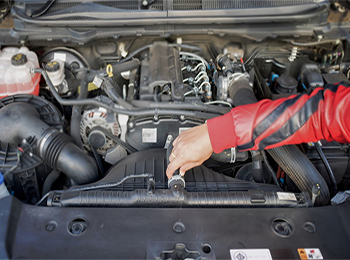
Why do some car owners charge for gas after changing the gas?
There are many factors that contribute to gas consumption, such as mixing ratios that are too strong, insufficient power, and the condition of the car itself, as well as the driver's personal driving habits, road conditions, and load capacity.
Why do some car owners complain that their car lacks power and starts slowly after changing the gas?
Firstly, the original vehicle itself has a malfunction, such as a faulty ignition system; Secondly, the mixing ratio adjustment is incorrect
Why do some car owners complain that their car's idle speed is unstable and even stalls when they first turn on the gas after changing the gas?
Due to the cooling of the car, the rich mixture of burning gas during the cooling process leads to unstable idle speed
Why does the fault light keep on after the car has been changed to gas?
After changing the gas, the fault light is on, but it does not mean that there is a problem with the engine. Generally, if the fault light is on, it belongs to exhaust emission faults. When burning gas, the mixture ratio of fuel and air is thinner than when burning oil. Therefore, the oxygen sensor detects that the exhaust composition during burning gas is different from that during burning oil, and reports a false fault to the original car computer. This problem can be solved by installing an F01OBD simulator or using more advanced system software.
The pictures and articles are from the internet. If there is any infringement, please contact us to delete them.
prev:nothing
next:Pros and cons of an LPG system for cars: Is it right for you?
Popular articles
-
How the CNG Automotive S
Compressed natural gas (CNG) automotive systems
-
What Is CNG Pressure Red
The pressure reducer of natural gas vehicle is
-
Advantages Of CNG Gas V
Compressed natural gas vehicles are vehicles th
-
Reasons For High Gas Con
1. Original vehicle condition A. The tec
-

Differences Between Sing
Characteristics of Gas Single Point Device
-

How To Improve The Power
1. Install ignition advance angle What i
-

How The CNG Gas Vehicle
If you want to know – how does the CNG conversi
-

Advantages And Principle
LPG and CNG are two mainstream alternati





Latest comments
0piece comment
no comments, welcome to comment。